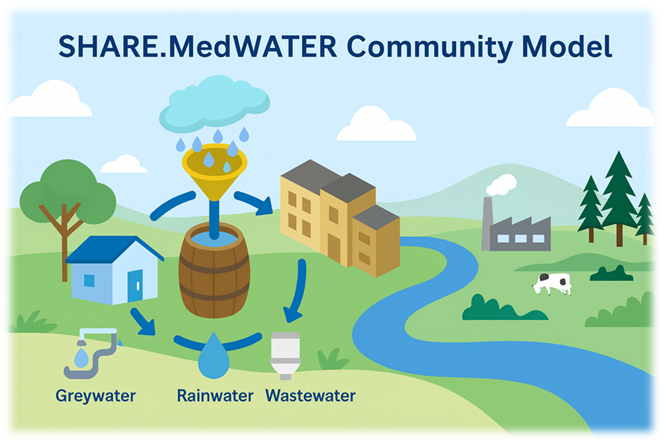
Strategic Harmonization and Resource Enhancement in the MEDiterranean: Advancing Water Management and Innovation through Non-Conventional Resources – SHARE.MedWATER project co-funded by Interreg Euro-MED Programme aims to tackle water scarcity by fostering the reuse of unconventional water sources through innovative treatment technologies, circular water strategies, and participatory governance models, promoting community-based approaches, knowledge sharing, and policy integration and supporting sustainable and resilient water management in the Euro-MED region.
The SHARE.MedWATER brings together 10 partners and 11 associate partners from 7 countries of the Mediterranean with a common objective, to directly addresses water scarcity in Euro-MED rural areas where climate change, erratic weather, and prolonged droughts are depleting freshwater reserves. The project responds by promoting alternative water sources—rainwater, greywater, wastewater—through storage, treatment, reuse, and shared management models to reduce reliance on overexploited surface and groundwater resources.
For the next 45 months starting from September 2025 until May 2029 partners will work together to address water scarcity by implementing 7 pilot community projects and scaling-up the model at district level. SHARE.MedWATER contributes to water sobriety—a shift toward more efficient, localized, and sustainable water use. These pilots will serve as scalable models, reinforcing resilience in water-scarce Med regions.
Total budget: €3,997,735.00
Project duration: September 2025 – May 2029 (45 months)
Interreg Funds: €3,198,188.00
Focus
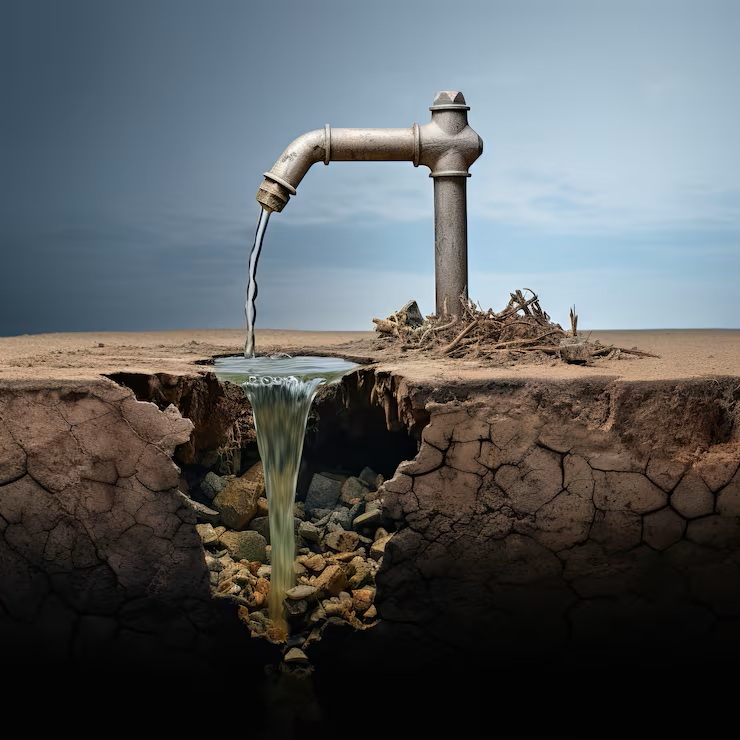
SHARE.MedWATER introduces innovative solutions and scales existing best practices to tackle water scarcity in Euro-MED rural and island regions. The project goes beyond conventional approaches by integrating non-conventional water reuse (rainwater, greywater, wastewater) at both community and district levels, addressing the lack of structured policies for decentralized water reuse. SHARE.MedWATER moves beyond existing solutions by:
⬥Addressing regulatory gaps: While EU Regulation 2020/741 focuses on wastewater reuse, the project expands water reuse solutions to rainwater and greywater, aligning with Directive (EU) 2024/3019.
⬥Bridging local and district scales: the project links decentralized (community) and centralized (district) water reuse models, creating scalable solutions applicable to multiple governance levels.
⬥Introducing a decision-support tool: the DSS will guide stakeholders in evaluating and optimizing unconventional water integration, considering economic, environmental, and social factors.
⬥Enhancing cross-border collaboration: the project’s capacity-building programme and cross-border cooperation framework ensure knowledge transfer and adaptation to different regional needs.
Latest
News
Upcoming
Events
No events to display at this time.
Key