Water Communities at the Centre of the Transition
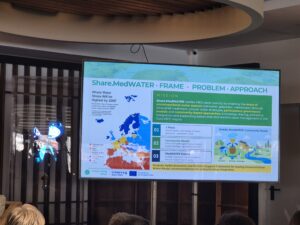
A central contribution of SHARE.MedWATER was advancing the discussion on water communities as an emerging governance model for the Mediterranean. The project promotes a shift toward participatory, community-based water management, combined with circular solutions such as the reuse of rainwater, greywater, and wastewater to address increasing water scarcity.
Through its seven pilot sites across the region, SHARE.MedWATER demonstrates how local communities can implement innovative and nature-based solutions, supported by decision-making tools and policy integration frameworks.
However, the project also brought a strong “reality check” to the discussion. Today, water management in the Mediterranean is highly fragmented and dominated by public utilities or concession-based systems, with almost no formal recognition of community-led water governance models.
From Energy to Water Communities
SHARE.MedWATER played a key role in the policy dialogue session “Green Living Areas: Institutional Policy Dialogue on Energy and Water Communities”, held on 20 May. The session explored how the success of energy communities in Europe can inspire the development of water communities, while also acknowledging the structural differences between the two sectors. SHARE.MedWATER highlighted critical insights, including:
- No existing legal framework currently recognises water communities in the Mediterranean countries analysed
- Strong regulatory and institutional barriers, including the public-service nature of water provision and concession-based systems.
- Significant operational challenges, such as financing gaps, liability risks, lack of infrastructure for sharing, and complex relationships with utilities.
These findings underline that, unlike energy communities, water communities are still at an early and experimental stage, often limited to pilot projects and local initiatives.
At the same time, the session emphasised that opportunities exist. By focusing initially on non-potable water uses and building on existing structures (such as cooperatives or energy communities), water communities can gradually become a viable governance model.
From Barriers to Opportunities
SHARE.MedWATER also contributed to outlining a pathway forward. The discussion stressed the need for:
- Legal recognition at EU level, similar to energy communities
- Adapted liability and regulatory frameworks for small-scale initiatives
- Dedicated financial incentives to support community investments
- Local umbrella structures to provide technical and administrative support
These elements are essential to move from pilot experimentation to scalable and replicable solutions across the Mediterranean.
Strengthening Cooperation within the ISE Community
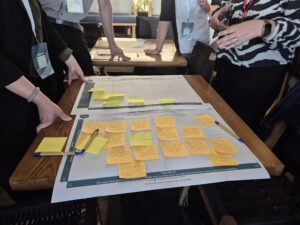
Beyond the session, SHARE.MedWATER actively engaged in the ISE Community of Practice, contributing to the Resource Valorisation thematic group and presenting its work in the Marketplace Village. This exchange fostered new synergies with other projects and reinforced a shared understanding that community-led governance models are key to sustainable resource management in the region.
Towards a New Water Governance Paradigm
SHARE.MedWATER’s participation in Athens confirmed the growing relevance of water communities as a strategic innovation for the Mediterranean. While significant regulatory and operational barriers remain, the project demonstrated that community-based approaches—combined with circular water solutions—offer a credible pathway toward resilience, sustainability, and local empowerment.
The discussions and outcomes from Athens will support the next steps of the project, contributing to the development of policy recommendations and practical tools to help water communities move from concept to reality across the region.