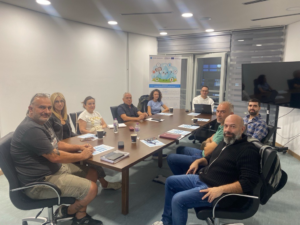
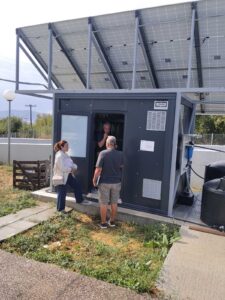
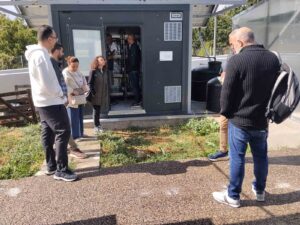
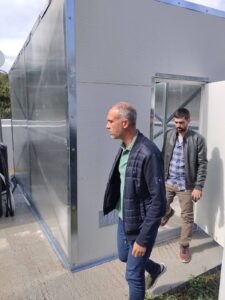
On 22 September 2026, the Centre for Research and Technology Hellas / Chemical Process and Energy Resources Institute (CERTH/CPERI) hosted the first Focus Group meeting of the Greek pilot of the SHARE.MedWATER project at its facilities in Ptolemaida, Western Macedonia.
The meeting brought together two representatives from the Department of Agriculture of the University of Western Macedonia, three representatives from the Municipality of Eordaia, a representative of the Regional Development Fund of Western Macedonia, as well as an electrical engineer and farmer, bringing together academic, institutional, technical and practical perspectives.
During the meeting, CERTH/CPERI presented the Greek pilot system in Ptolemaida, which focuses on the collection, treatment and reuse of rainwater for irrigation in hydroponic greenhouse cultivation.
The presentation was followed by an open discussion on local water-management needs, the potential use of non-conventional water resources and the main factors that may influence their practical application and wider acceptance.
Participants highlighted the potential contribution of alternative water sources to reducing pressure on conventional water resources, particularly in the agricultural sector. The environmental benefits of such approaches were also emphasised, together with their potential role in promoting a more responsible use of natural resources.
Water scarcity, especially during the summer months and in relation to the uneven seasonal distribution of rainfall, was identified as an important local challenge. In this context, rainwater harvesting and reuse were discussed as potential complementary solutions.
At the same time, participants stressed the importance of ensuring water quality and safety through appropriate chemical and biological monitoring. The influence of local environmental conditions, including air quality, on collected rainwater was also discussed.
The discussion also explored the potential of small-scale rainwater harvesting systems in individual houses for non-potable uses, as well as agricultural applications such as the use of treated rainwater in hydroponic systems. The possible recovery and reuse of water generated through condensation processes was also identified as an interesting area for further investigation.
Another important point concerned public awareness and education. Participants highlighted the value of information and demonstration activities, including possible actions involving schools, in order to strengthen awareness of responsible water use and improve the social acceptance of non-conventional water resources.
Following the discussion, participants visited the Greek pilot installation, where they had the opportunity to see the main components of the system and discuss its planned operation, rainwater collection and treatment, and its integration with the hydroponic greenhouse.
The visit provided an opportunity to discuss practical aspects of the pilot directly on site and to connect the issues raised during the Focus Group with the actual system under development.
Overall, the meeting highlighted the potential of non-conventional water resources as a complementary approach to addressing water scarcity, while also underlining the importance of water quality, technical feasibility, public awareness and social acceptance.
Participants also expressed their interest in following the progress of the Greek pilot and in participating in future Focus Group meetings, as well as receiving updates on the development of activities in the other SHARE.MedWATER pilot areas.